

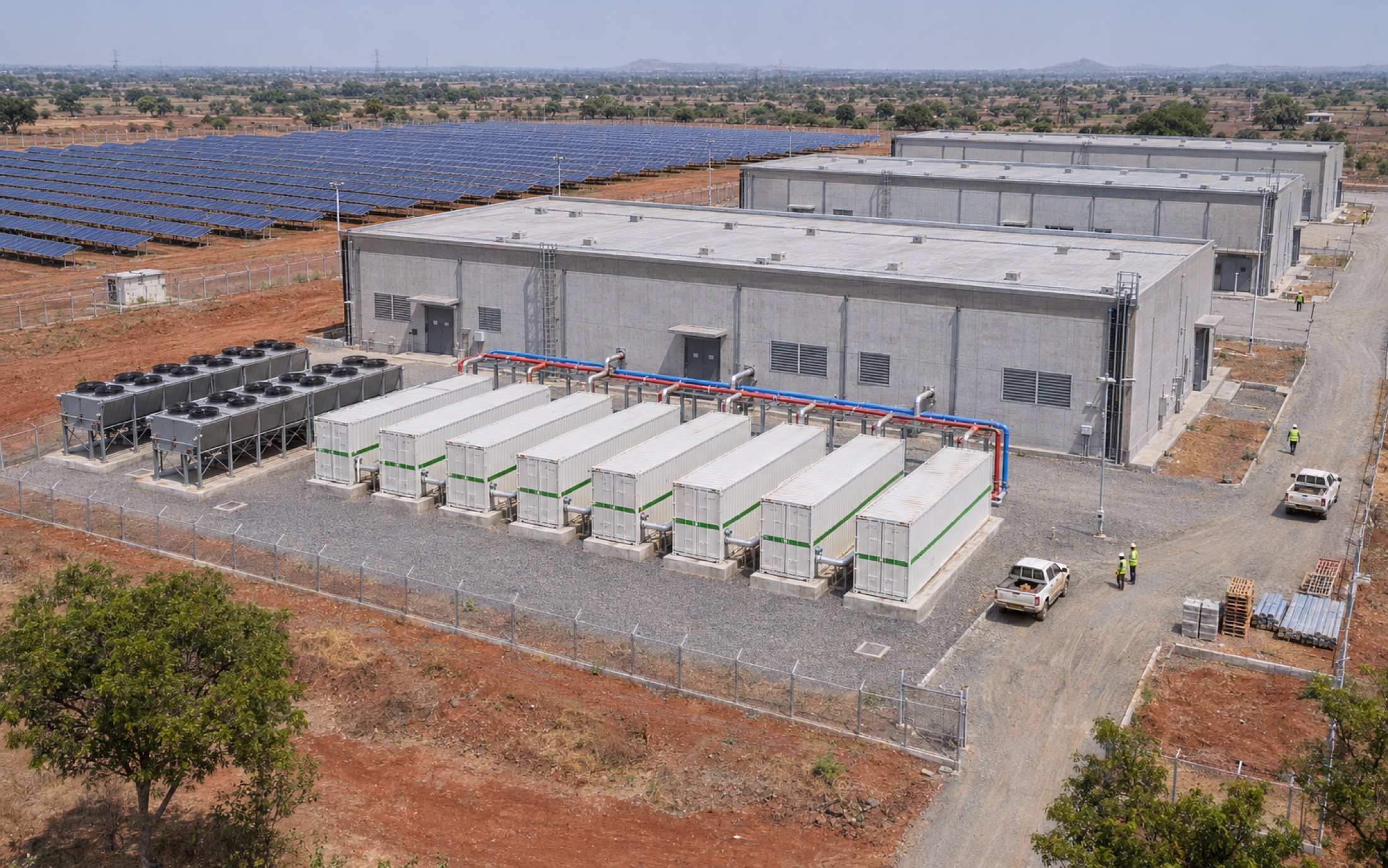
In India, where most data center capacity sits in water-stressed cities, Coldsun is designed to cool with no water and about a third of the grid power of a chiller and cooling tower.
Design targets from our 5 MW reference model. Not yet measured in the field.
Power that never reaches a GPU
Up to 30% of a facility's power can go to cooling. Every kilowatt spent on chillers is a kilowatt your grid connection cannot give to compute.
YC and industry estimatesCapacity in water-stressed cities
About 65% of India's data center capacity sits in three metro regions under significant water stress. Evaporative cooling uses more water as temperatures rise.
CEEW analysisClean power with nowhere to go
India curtailed about 300 GWh of renewable power in the first quarter of 2026 because the grid could not carry it at midday.
Ember, via Business TodayGreen power is becoming a rule
Gujarat's data center policy for 2026–29 requires at least 51% green power. Maharashtra has set the same threshold.
State data center policiesCharge at noon
Chillers run on midday solar, when power is cheapest, and freeze a phase-change medium in insulated tanks.
Hold the cold
Each container stores 2.5 MWh of cooling beside the hall and loses under 1% a day.
Cool at night
Stored cold feeds your chilled-water loop. Dry coolers reject the heat to air, so no water is lost.
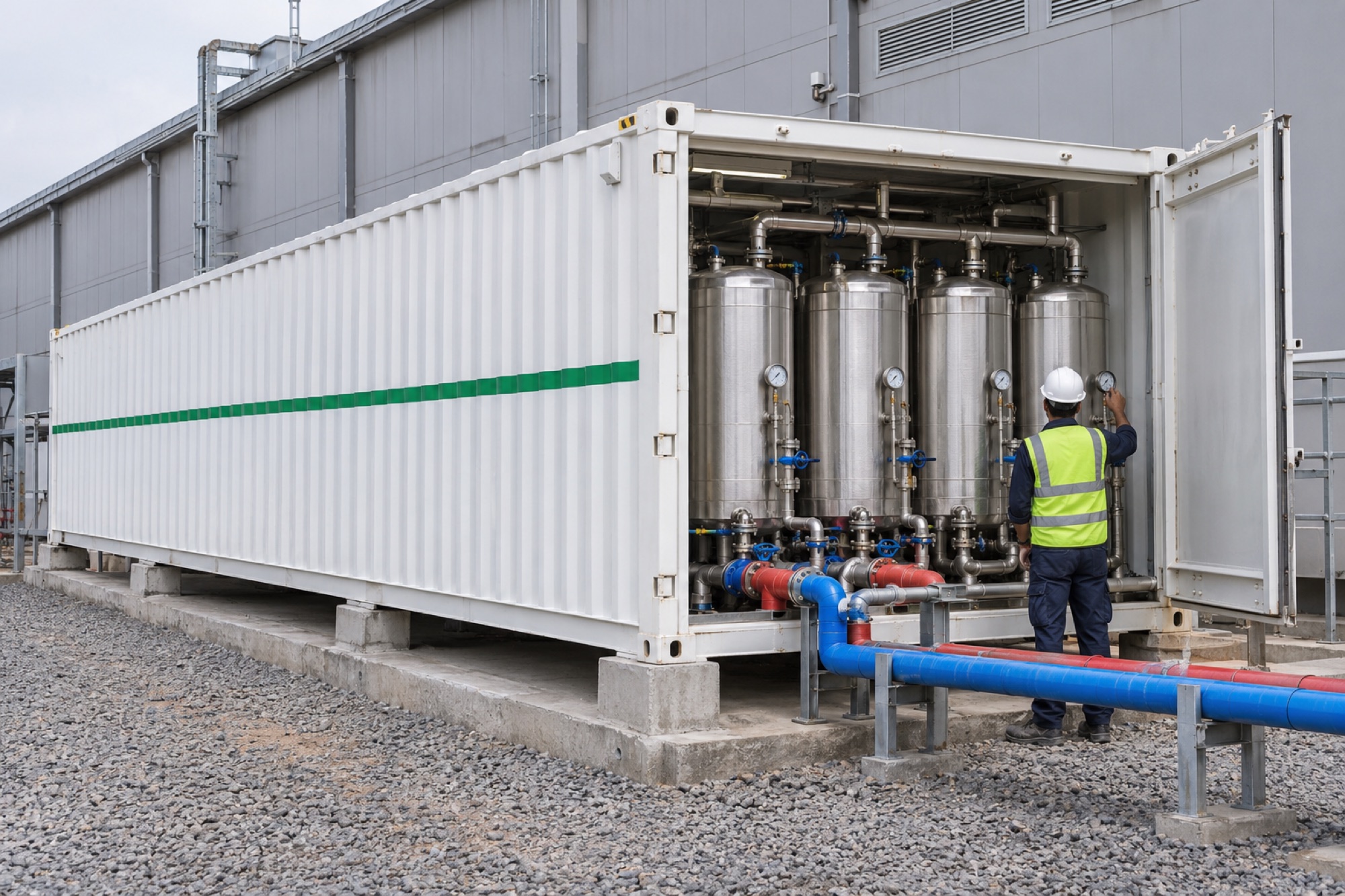
Inside a Sunvault module: four insulated tanks on a standard container frame. Illustrative render.
A data hall needs cooling every hour of the year. The cheapest, cleanest power in India arrives for about seven hours around noon. Today those two facts do not meet: chillers draw grid power around the clock, hardest in the evening when the grid is most stretched.
Batteries could bridge the gap, but storing electricity is expensive. Storing cold is not. When water freezes it gives up about 93 watt-hours of heat per kilogram, and it takes the same amount back in when it melts. A tank of phase-change material is a simple, long-lived way to hold a night's worth of cooling.
So Coldsun moves the work of cooling to the hours when power is abundant. Chillers run hard on midday solar and freeze the tanks. From evening to morning the tanks melt and absorb the hall's heat, with the chillers off.
Tanks are nearly empty after the night. Dry coolers carry part of the load in the cool morning air.
Solar output passes the hall's cooling demand. Chillers start and the surplus begins freezing the tanks.
Peak solar. Chillers cool the hall directly and charge storage at full rate.
Tanks are full. The hottest part of the day is covered by solar and stored cold together.
The sun is down and the grid is at its evening peak. Chillers switch off. The tanks take over.
Stored cold and cool night air carry the full load. Grid draw for cooling is close to zero.
Concept model, not to scale. Drag to rotate, tap a number, or switch between noon and midnight.
Simplified flow. Green is electricity, blue is cold water, orange is heat.
Schematic cutaway, not to scale. The blue level shows the tanks charging and discharging.
Rough estimate, not a quote. Assumes cooling is 30% of IT load, 65% of it moves off the grid, and a cooling tower would evaporate 1.8 L per kWh of IT load. A site assessment replaces these with your own data.
Thermal battery
A 40 ft insulated container holding four phase-change tanks. It charges on solar power and discharges into a standard chilled-water loop. Add containers as the hall grows.
Heat rejection
Dry coolers sized for 46°C ambient. On the hottest afternoons the plant draws on stored cold rather than spraying water.
Control software
Schedules charging against solar output, tariffs, weather and IT load, and reports water and carbon every month.
| Per 5 MW IT hall | Chiller + tower | Coldsun |
|---|---|---|
| Water evaporated | Continuous | None |
| Cooling energy from the grid | 100% | ~35% |
| Grid draw for cooling at evening peak | Full load | Near zero |
| Upfront cost to the operator | Full capex | ₹0 |
| Supply water temperature | 7–18°C | 18–24°C |
Coldsun figures are design targets from our reference model. Pilot data will replace them.
New AI halls
Meet state green-power rules from day one and hold 18–24°C supply water in 46°C ambient without a cooling tower.
Retrofit existing halls
Connect to the chilled-water loop you already have. Your chillers stay in place as backup.
Site assessment
We model your hall, climate and tariff, and send a savings and water estimate. Free.
Design and contract
Layout for containers, dry coolers and pipe routes, plus the cooling-as-a-service agreement.
Install and commission
Containers arrive pre-assembled. We tie into the chilled-water loop without taking the hall offline.
Operate and report
We run the plant, meter the cooling delivered, and send a monthly water and carbon report.
Indicative schedule for a pilot. Actual timing depends on the site.
Cooling as a service
We design, install, own and operate the plant. You pay a metered rate per ton-hour, set below your current cost.
Free site assessment
We model your hall and climate, then send a savings and water estimate in about two weeks.
Sources: CEEW (water stress), Gujarat Data Centre Policy 2026–29.
Reference design
Complete the 5 MW reference model and the cost model with real Indian tariffs.
Three pilots
One Sunvault module each on 1–2 MW halls, measured for a full summer.
First 10 MW plant
A commercial deployment priced on measured pilot data.
Is this proven?
Thermal storage and dry cooling are both mature technologies used in buildings and industry for decades. Our integrated system for data centers is at the design stage, and our first pilots are planned for 2027.
Why store cold and not electricity?
A tank of phase-change material costs far less per unit of cooling than a battery plus a chiller, has no fire risk, and does not wear out with daily cycling in the same way.
How can cooling use no water?
Dry coolers reject heat to air through sealed coils, like a car radiator. They lose capacity on very hot afternoons, which is when we use solar and stored cold instead of spraying water.
What happens on cloudy days or in the monsoon?
The tanks can also charge from the grid at off-peak night rates. Monsoon months are cooler, so dry coolers carry more of the load directly.
What if the stored cold runs out?
Your existing chillers stay connected and take over automatically. The hall never depends on storage alone.
Does it work with liquid-cooled AI racks?
Yes. Direct-to-chip racks accept warmer water, which suits an 18–24°C supply and makes dry cooling easier.
Can it be added to an existing data hall?
Yes. It ties into the chilled-water header through a heat exchanger. Nothing changes inside the white space.
How much space does it need?
Each module is one 40 ft container on concrete plinths. The reference 5 MW hall uses eight containers and two dry cooler banks on a gravel pad beside the building.
Do we need our own solar plant?
No. On-site solar works, and so does green power bought through open access. What matters is that charging happens in solar hours.
What does it cost?
Nothing upfront. You pay a rate per ton-hour of cooling delivered, set below what the same cooling costs you in chiller power today.
Who owns and maintains the plant?
Coldsun does. We design, install, own, operate and maintain it for the life of the contract.
How do you report water and carbon savings?
Coldsun OS meters cooling delivered, grid power used and solar share, and produces a monthly report you can use for ESG and BRSR filings.
We are selecting three data center sites in India for our 2027 pilots.
Tell us about your site →