

Technology
A thermal battery, dry coolers and control software, built to run a data hall's cooling on daytime solar.
Cooling demand runs all day and night. Solar power is abundant for about seven hours. Electricity is expensive to store, but cold is cheap to store: a tank of frozen phase-change material holds its temperature for a day with very little loss.
Coldsun runs high-efficiency chillers when solar power is plentiful, freezes the storage medium, and then melts it through the evening and night to chill the water your racks need. Heat is rejected to air through dry coolers, so the plant does not evaporate water.
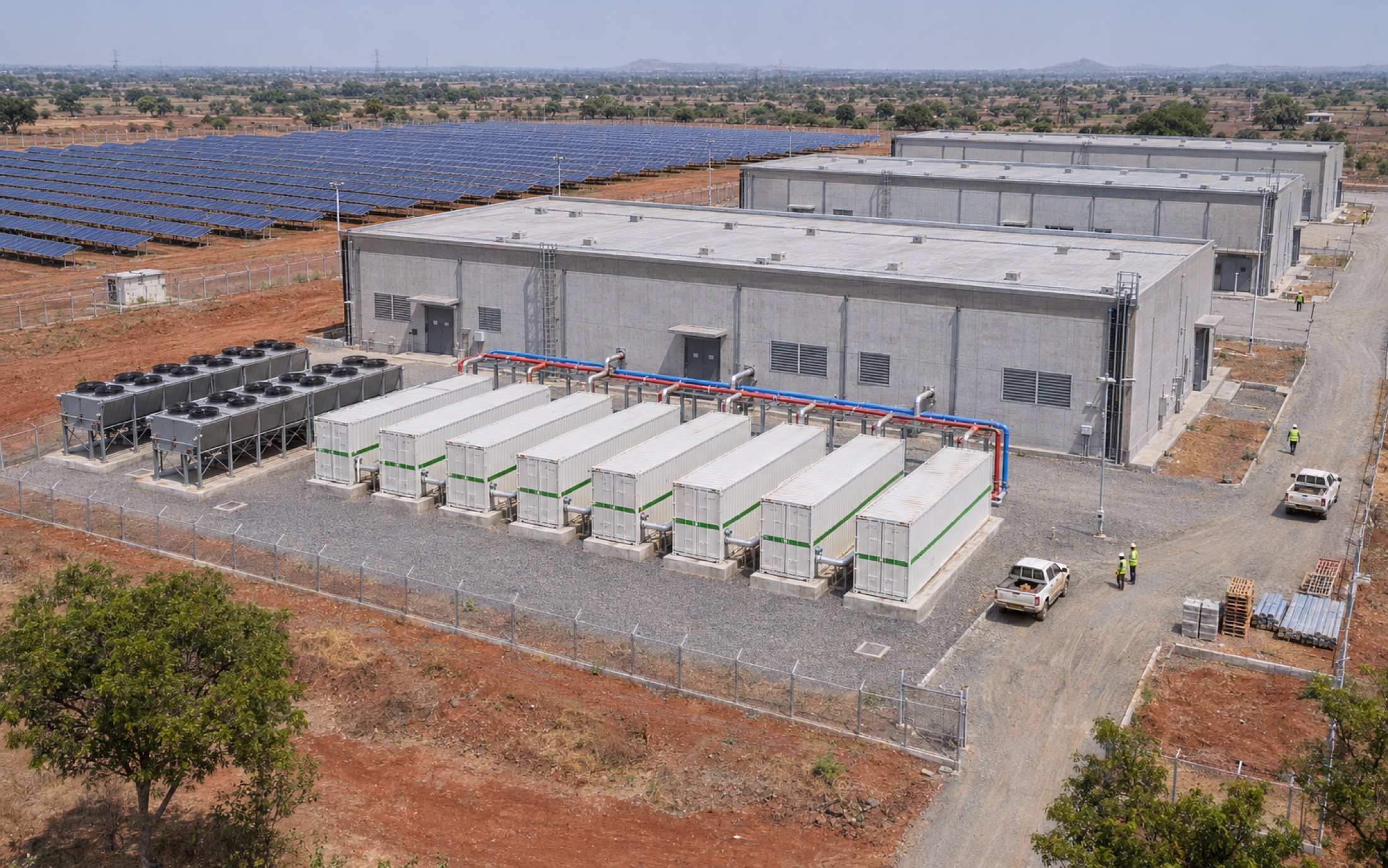
Reference layout for a 5 MW IT hall: solar field, eight storage containers and two dry cooler banks. Illustrative render.
A 40 ft insulated container on a concrete plinth. Inside are four stainless steel tanks filled with a phase-change medium, a plate heat exchanger, and the pumps and valves that connect to your chilled-water loop.
| Cooling stored per module | 2.5 MWh |
| Discharge window | up to 14 h |
| Standing loss | under 1% a day |
| Footprint | 1 × 40 ft container |
| Connection | Standard chilled-water loop |
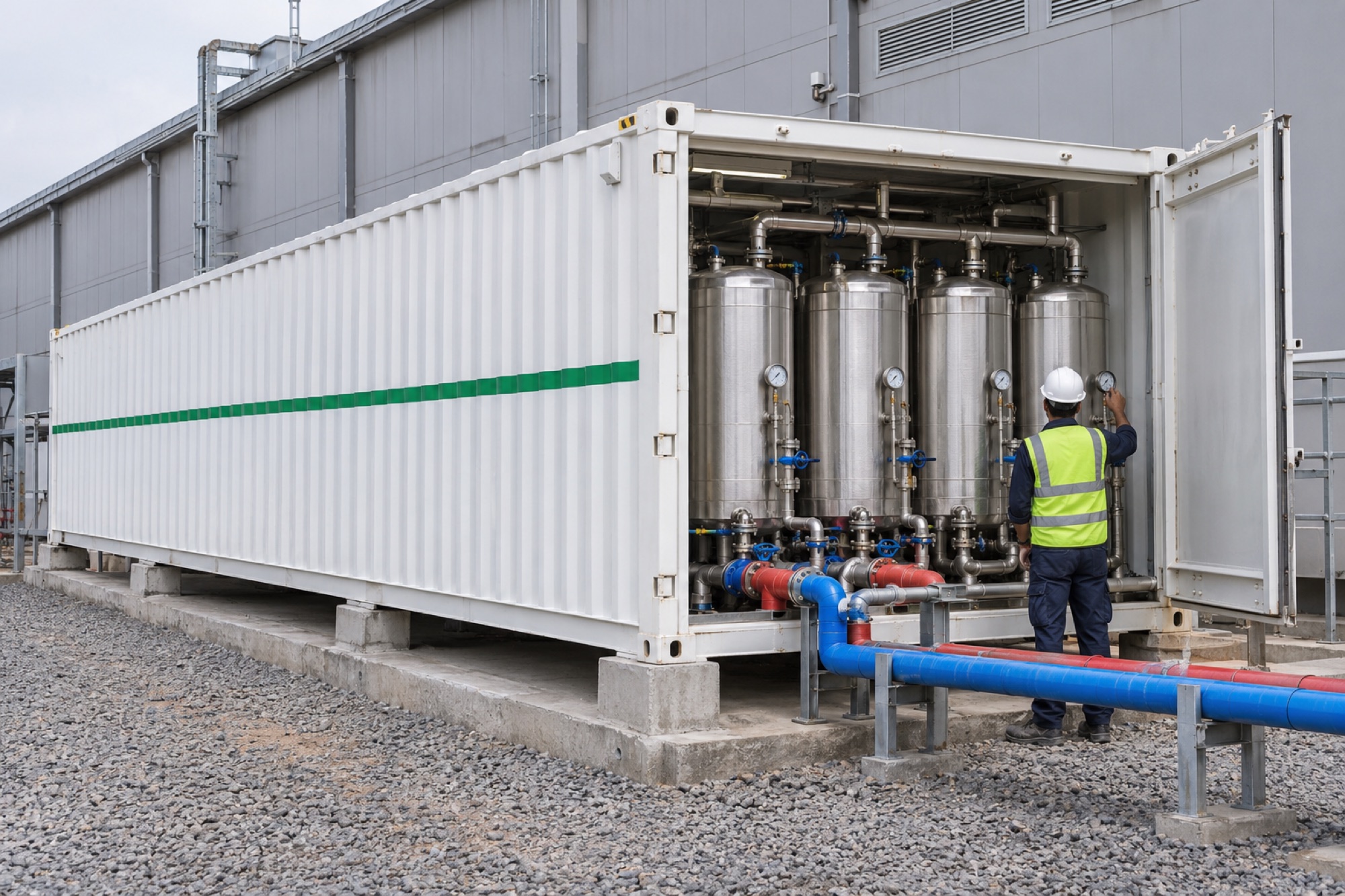
Inside a Sunvault module. Illustrative render.
Banks of dry coolers reject heat to ambient air through sealed coils and fans. Dry coolers lose capacity on very hot afternoons. That is the same window in which the tanks are full and solar is strong, so the plant leans on stored cold and does not need an evaporative assist.
| Water evaporated | None |
| Design ambient | 46°C |
| Supply water | 18–24°C |
| Cooling tower | Not required |
The software decides, every few minutes, whether to charge, hold or discharge. It uses:
- solar forecast for the next 36 hours
- ambient temperature and humidity forecast
- IT load and rack inlet temperature
- grid tariff by time of day
Operators see cold stored, solar share, grid draw and water saved on one screen, and receive a monthly water and carbon report suitable for ESG and BRSR filings.
Ties into the existing chilled-water header through a plate heat exchanger. The hall's water never mixes with the storage medium.
Charges from on-site solar or green open-access power. It can also charge from the grid at off-peak rates.
Existing chillers stay in place and take over automatically if stored cold runs low.
A gravel pad beside the hall with concrete plinths. No changes inside the white space.
We would rather say this ourselves than have you find it later.
- Field performance. Every figure on this site is a design target from a reference model. None has been measured on a live hall yet.
- Peak summer. Holding supply temperature through a 46°C week in Chennai or Hyderabad needs a full-season pilot.
- Cost. Our pricing depends on thermal storage costing less per unit of cooling than batteries plus chillers at Indian tariffs. We are validating that model site by site.
The 2027 pilots exist to answer these three questions with data.